The most useful thing about the 2026 craft beer data is that it refuses to tell a simple story. Production is down. Market share is up. Brewery counts are falling. Visits per drinker are rising. Anyone selecting one of those to prove a point is doing it deliberately.
Read together, the numbers point somewhere specific, and it is not where most commentary lands. Craft beer does not have a beer problem. It has an attention problem.
The 2026 midyear picture
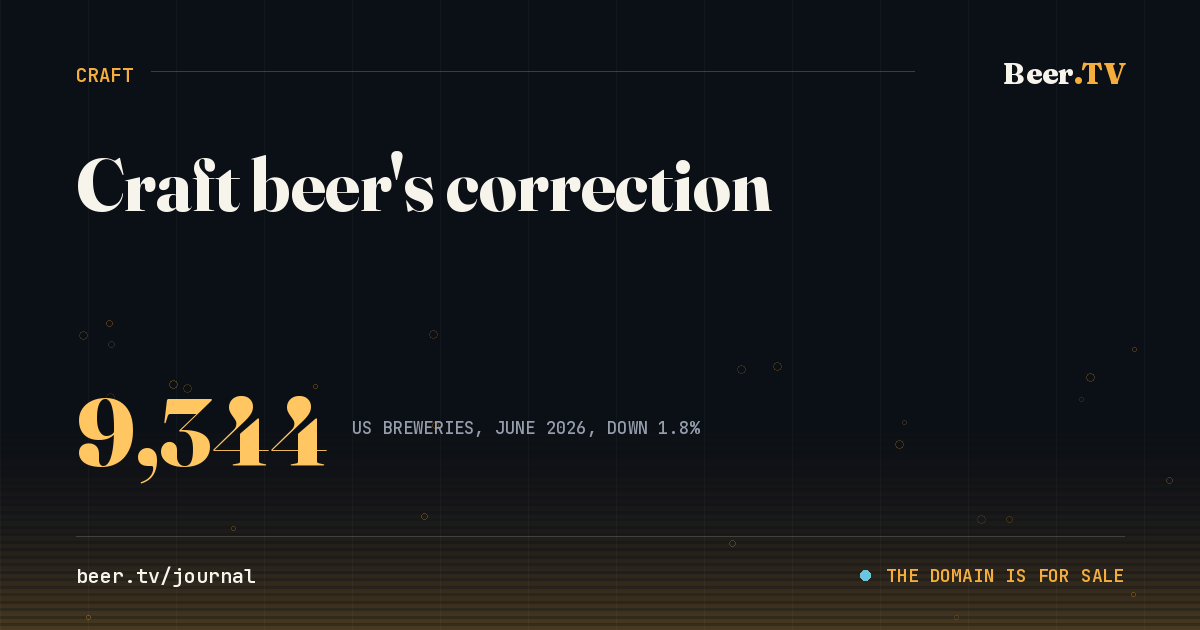
The Brewers Association reported 9,344 breweries operating in June 2026, down 1.8 percent from 9,515 a year earlier. That is a slight acceleration from the 1 percent decline recorded in the first half of 2025. Regional breweries and microbreweries each fell 3 percent, taprooms 2 percent, and brewpubs 1 percent. Craft volume declined an estimated 4 percent in the first half of 2026.
US breweries operating in June 2026, down 1.8 percent year over year. Microbreweries and regional breweries fell fastest at 3 percent each. Brewpubs, the most hospitality driven format, fell least at 1 percent.
Brewers Association, 2026 Midyear ReportThe pattern inside that breakdown is the story. The formats losing ground fastest are the ones that depend most on distribution and shelf space. The format holding up best is the one where the customer walks in the door. That distinction runs through everything else here.
What 2025 actually finished at, including the correction
The full year 2025 figures are worth setting out carefully, because the Brewers Association issued an unusual public revision to them, and both versions are still circulating.
| Metric | April 2026 report | June 2026 correction |
|---|---|---|
| Total craft production | 21,856,000 bbls, down 5.1% | 22,034,000 bbls, down 4% |
| Craft brewing jobs | Larger decline reported | 191,000 jobs, down 3% |
| Craft volume share | 13.3% | 13.4%, up from 13.2% |
On the corrected numbers, 60 percent of breweries reported declines, 39 percent reported growth, and 1 percent held steady. Craft's retail dollar value fell 2.8 percent year over year to $28.0 billion. Critically, craft outperformed the wider beer category, which declined 5.7 percent by volume, which is how a shrinking segment ends up with a slightly larger share.
New brewery openings dropped sharply to 300 in 2025, down from 518 in 2024, while closures fell to 481 from 591. Fewer people are opening breweries, and slightly fewer are closing them. That is what the bottom of a cycle usually looks like from inside it.
The number that contradicts the narrative
Here is where it gets interesting. In the 2026 Brewers Association and Harris Poll consumer survey of more than 2,000 adults, monthly craft consumption among craft drinkers reached 85 percent, up 10 percentage points year over year and the highest level since 2019 to 2020. Craft drinkers visited breweries an average of 5.5 times over the past year, up from 5.1 in 2025.
Monthly craft consumption among craft drinkers hit its highest level since 2019 to 2020, and average brewery visits per drinker rose year over year, at the same time as production and brewery counts fell.
Brewers Association and Harris Poll 2026 Consumer SurveyVolume is falling while engagement is rising. Those two facts cannot both be about beer quality or beer demand. People who like craft beer are drinking it more often and visiting breweries more often. The contraction is happening somewhere else.
Where the contraction is actually happening
The Brewers Association names the causes directly across its 2025 and 2026 reporting: changing consumer behaviour, retailer and wholesaler rationalisation, cost increases from inflation and tariffs, and more competition than ever.
Two of those four are attention problems dressed as logistics problems.
Retailer rationalisation means shelf space is being cut. When a retailer reduces facings, it keeps the brands that turn. Brands turn when people arrive at the shelf already knowing what they want. That is a demand generation outcome, decided long before the customer reaches the store.
More competition than ever is the clearer one. Nearly ten thousand breweries are producing a genuinely excellent product. Quality has stopped being a differentiator because it has become the baseline. Craft beer solved brewing. It did not solve being known.
The Brewers Association's own read is consistent with this. Its 2026 analysis of brewery visits concludes that the challenge for individual businesses is turning visits into stronger performance through positioning, hospitality, and giving customers a clear reason to choose their taproom. Positioning and a clear reason to choose are not brewing problems.
In a category with 9,344 producers, being known is the constraint. Beer.TV is the most recallable address in the category, available once, to one owner.
Make an offer on Beer.TVThe distribution versus destination split
Look again at which formats are shrinking fastest. Microbreweries, which are distribution focused, fell 3 percent. Regional breweries, also distribution dependent, fell 3 percent. Brewpubs, which are effectively restaurants that brew, fell 1 percent.
Beervana's read on the full year 2025 segment declines shows the same slope: brewpubs down 1.7 percent, taprooms down 3.9 percent, regional breweries down 5.9 percent, and microbreweries down 8.9 percent. The further a business model sits from the customer, the harder it has been hit.
That is the central strategic finding of this cycle. Owning the relationship is now more defensible than owning the shelf. We look at what that means practically in the taproom piece.
The lesson for the segment growing right now
Non alcoholic beer in 2026 looks, structurally, a lot like craft beer in 2012: early, fragmented, growing fast, and attracting entrants who assume the growth curve is the strategy. We set out the full picture in the zero proof analysis.
Craft's experience is the cautionary version of that story. From roughly 2,000 breweries to nearly 10,000 in a decade, the product stayed excellent and the economics still broke, because supply outran attention. The brands that came through are the ones that built a direct relationship with drinkers before they needed one.
Anyone building in a fast growing beverage segment in 2026 should read the craft numbers not as a warning about beer, but as a warning about what happens when every competitor is good.
What we would take from this
- US brewery counts fell 1.8 percent to 9,344 in June 2026, with distribution led formats falling fastest and hospitality led formats holding up best.
- Craft production fell 4 percent in 2025 on corrected figures, to 22,034,000 barrels, while share rose to 13.4 percent because the wider category fell faster.
- Engagement went the other way: 85 percent monthly consumption among craft drinkers, up 10 points, and 5.5 brewery visits per drinker, up from 5.1.
- The constraint is not demand or quality. It is attention, shelf access, and being the brand someone already had in mind.
Nine thousand three hundred and forty four breweries make good beer. Almost none of them own a piece of naming that the whole category would recognise instantly. That is what is actually for sale here.
About this analysis
Who wrote it. Beer.TV Research is the in house analysis desk for Beer.TV. We are not brewers, brokers or market researchers, and we do not sell data. We are the owner of a category domain, and we publish the same research we used to understand what that domain sits on top of.
How the numbers were gathered. Every figure is taken from a named primary source, published in 2025 or 2026, and linked in the sources list at the foot of this page. Where two credible sources disagree, both are shown and the reason for the gap is explained rather than smoothed over.
What it is not. This is commercial and market commentary. It is not investment advice, legal advice, or a recommendation to buy or consume any product. Market forecasts from research firms are modelled estimates, not audited results, and should be read that way.
Almost none of them own a piece of naming the whole category would recognise instantly. There is one Beer.TV and it transfers once.
Take it off the marketRead next
Sources
- Brewers Association, 2026 Midyear Report, July 2026. Brewery counts, segment declines, Harris Poll consumer survey data.
- Brewers Association, A Year of Correction for Craft Beer, updated 29 May 2026. Corrected 2025 production, share and retail value.
- New School Beer, Major Revisions to the Brewers Association's 2025 Industry Production Report, June 2026. Detail on the April to June revision, openings and closings.
- Beervana, The Final Numbers for Craft Beer in 2025, April 2026. Segment level declines by brewery type.
- Brewers Association, The 2025 Year in Beer, December 2025. Openings, closings and named industry headwinds.
- Brewers Association Insights, Brewery Visits Are Up, 2026. Visit frequency analysis and positioning commentary.